For centuries, plant-derived repellents have been used to help keep mosquitoes at bay. But scientists didn’t fully understand how these compounds actually worked inside the insect’s brain. New research by an international team led by Baylor University changes that understanding and could help lead to next-generation mosquito repellents protecting human health.
Published in Nature Communications, the groundbreaking study reveals mosquitoes use a specific sensory receptor to detect – and avoid – borneol, a naturally occurring organic compound found in several aromatic plants, including Camphor trees, Rosemary and other aromatic herbs.
A natural warning system

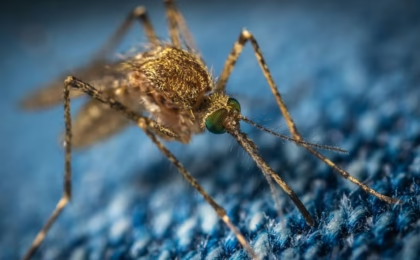
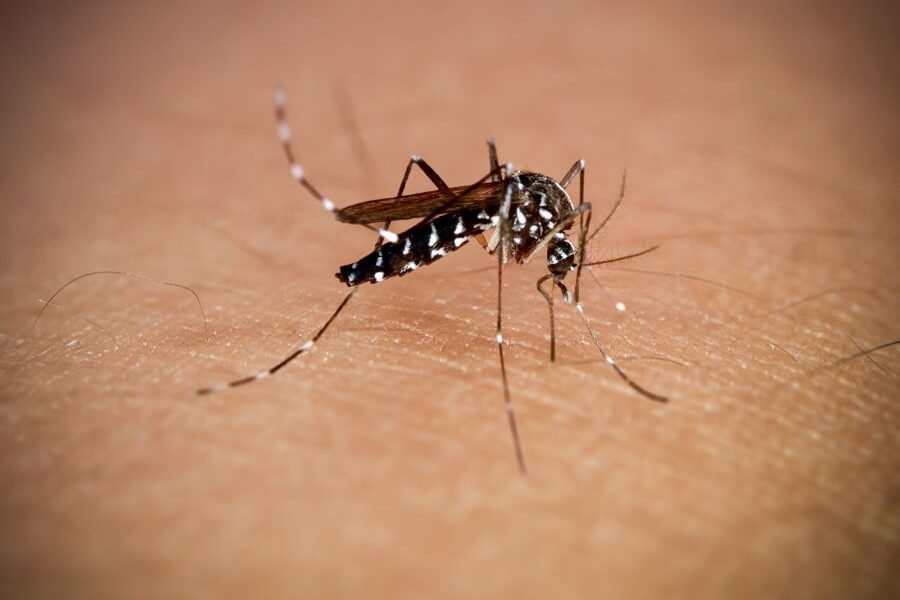
The research team, including Jason Pitts, Ph.D., associate professor of biology at Baylor and a corresponding author on the study, discovered that Aedes aegypti mosquitoes – one of the most widespread mosquitos in the world – appear to have a built-in borneol warning system: a single odor receptor called OR49 that is highly tuned to detect borneol.
The research found that when a mosquito encounters this compound, OR49 activates a specific nerve cell in one of its primary organs for detecting odors and locating human hosts, the maxillary palp. That signal then travels to a distinct region of the mosquito’s brain, triggering avoidance behavior, Pitts said.
To test how critical this receptor is, the researchers genetically disabled OR49. Without OR49, the repellent signal essentially disappeared. The mosquitoes’ neurons no longer responded to borneol and the insects were far less likely to avoid it when seeking a human.
Impact on human health
Mosquito-borne diseases like dengue, malaria and Zika continue to threaten millions worldwide. This study provides a clear biological explanation for how at least one natural compound works to protect humans from mosquitoes.
By identifying the exact receptor and neural pathway responsible for repelling the mosquito, scientists now have a more precise target for designing future deterrents. Instead of broadly disrupting mosquito behavior, researchers may be able to develop compounds that directly activate specific avoidance pathways. Pitts said understanding how mosquitoes “smell danger” could lead to smarter, more effective ways to protect people from disease.
“Because the repellency through the Or49 receptor is so strong, we might be able to identify other volatile odors that activate the same receptor to ‘push’ mosquitoes away from people,” Pitts said. “The new compounds might be easier and cheaper to produce, or safer and more acceptable to the human nose than existing repellent formulations.”
This research bridges basic neuroscience and public health, offering fresh insight into how tiny sensory signals can have life-saving implications. That is central to the premise of their research, which was funded by the National Institute of Allergy and Infectious Diseases (1R01AI148300-01A1): to understand the genetic basis for attraction to sources of nectar in Aedes aegypti, the major carrier of dengue and yellow fever viruses.
Beyond informing personal protective formulations and devices, research like this will lead to the development of a new generation of mosquito attractants that can be used in traps for enhancing mosquito surveillance and control in combination with existing methods.
“The knowledge gained in these studies will inform similar studies in mosquitoes that transmit malaria, plus other biting insects that continue to exert negative impacts on human flourishing on a global scale,” Pitts said.
ABOUT THE AUTHORS
Department of Entomology, The Hebrew University of Jerusalem, Rehovot, Israel
Yuri Vainer, Ph.D., Evyatar Sar-Shalom, Ph.D., Yinliang Wang, Ph.D., Dor Perets, Ph.D., Esther Yakir, Ph.D., Philippos A. Papathanos, Ph.D. and Jonathan D. Bohbot, Ph.D.
Agriculture Gene Engineering Research Center of the Ministry of Education, Northeast Normal University, Changchun, China
Yinliang Wang, Ph.D.
Department of Biology, Baylor University, Waco, USA
Robert M. Huff, Ph.D., Dhivya Rajamanickam, Ph.D., and Ronald Jason Pitts, Ph.D.
Department of Plant Protection Biology, Swedish University of Agricultural Sciences, Alnarp, Sweden
Majid Ghaninia, Ph.D. and Rickard Ignell, Ph.D.
School of Biological Sciences, Department of Cell and Developmental Biology, University of California San Diego, La Jolla, CA, USA
Iliano V. Coutinho-Abreu, Ph.D. and Omar S. Akbari, Ph.D.
Department of Biology, University of Washington, Seattle, WA, USA
Carlos Ruiz, Ph.D. and Jeffrey A. Riffell, Ph.D.
Department of Microbiology and Molecular Genetics, The Hebrew University of Jerusalem, Jerusalem, Israel
Alon Warburg, Ph.D.
ABOUT BAYLOR UNIVERSITY
Baylor University is a private Christian University and a nationally ranked Research 1 institution. The University provides a vibrant campus community for 20,000 students by blending interdisciplinary research with an international reputation for educational excellence and a faculty commitment to teaching and scholarship. Chartered in 1845 by the Republic of Texas through the efforts of Baptist pioneers, Baylor is the oldest continually operating University in Texas. Located in Waco, Baylor welcomes students from all 50 states and more than 100 countries to study a broad range of degrees among its 12 nationally recognized academic divisions. Learn more about Baylor University at www.baylor.edu.
ABOUT THE COLLEGE OF ARTS & SCIENCES AT BAYLOR UNIVERSITY
The College of Arts & Sciences is Baylor University’s largest academic division, consisting of 25 academic departments in the sciences, humanities, fine arts and social sciences, as well as 11 academic centers and institutes. The more than 5,000 courses taught in the College span topics from art and theatre to religion, philosophy, sociology and the natural sciences. The College’s undergraduate Unified Core Curriculum, which routinely receives top grades in national assessments, emphasizes a liberal education characterized by critical thinking, communication, civic engagement and Christian commitment. Arts & Sciences faculty conduct research around the world, and research on the undergraduate and graduate level is prevalent throughout all disciplines. Visit the College of Arts & Sciences website.